
Golf Swing Basics: Proper Grip, Stance, and Posture
The journey to a better golf game begins long before you swing the club. The foundation of every great golf swing lies in three critical elements: grip, stance, and posture. These fundamentals might seem simple, but they're often the difference between frustration and success on the course. Whether you're just starting out or looking to rebuild your swing from the ground up, mastering these basics will set you on the path to more consistent, powerful, and accurate shots.

The three fundamentals that form the foundation of every great golf swing
Why Mastering These Fundamentals Matters
Before diving into the specifics, it's important to understand why these three elements are so crucial. Your grip is your only physical connection to the club. Your stance creates the foundation for balance and power. Your posture determines your ability to rotate properly and maintain consistency throughout your swing.
When these fundamentals are correct, your body can naturally perform the complex movements of a golf swing. When they're wrong, you'll find yourself making compensations that lead to inconsistency and frustration.
"The grip is your only connection to the golf club. Get this right, and you're halfway to a good golf swing."
Let's break down each fundamental and learn how to master them one by one.
Proper Grip: Your Only Connection to the Club
Your grip is where everything begins. It's the only point of contact between you and the golf club, making it perhaps the most critical element of your setup. A proper grip allows you to control the clubface and square it at impact, which is essential for hitting straight, consistent shots.
The three common grip types: Overlapping (Vardon), Interlocking, and Baseball (Ten-finger)
Three Types of Golf Grips
There are three main grip styles in golf, and all can be effective depending on your hand size, strength, and personal preference:

Overlapping (Vardon) Grip
The most common grip among professional golfers. The pinky finger of your trailing hand (right hand for right-handed golfers) rests on top of the index finger of your lead hand.
Best for: Players with larger hands or stronger forearms.
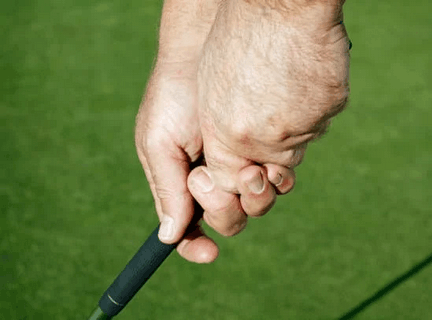
Interlocking Grip
The pinky finger of your trailing hand interlocks with the index finger of your lead hand. This creates a more unified connection between both hands.
Best for: Players with smaller hands or less grip strength. Used by Tiger Woods and Jack Nicklaus.
Baseball (Ten-finger) Grip
All ten fingers are placed on the club with no overlapping or interlocking. Your hands sit next to each other on the grip.
Best for: Beginners, juniors, or players with arthritis or hand injuries.
How to Position Your Hands
Regardless of which grip style you choose, the position of your hands on the club is crucial:
Proper hand position showing the 'V' formation pointing toward the trailing shoulder
Lead Hand Position (Left hand for right-handed golfers)
- Place the club handle diagonally across your fingers (not in your palm)
- Close your hand so the thumb rests slightly right of center on the grip
- You should see 2-3 knuckles of your lead hand when looking down
- The "V" formed between your thumb and index finger should point toward your trailing shoulder
Trailing Hand Position (Right hand for right-handed golfers)
- Place the lifeline of your palm over the thumb of your lead hand
- Close your fingers around the grip
- The "V" formed by your thumb and index finger should also point toward your trailing shoulder
- Your trailing hand should sit more on the side of the grip than on top
Grip Pressure: The Goldilocks Zone
Grip pressure is often overlooked but extremely important. On a scale of 1-10 (with 10 being the tightest), aim for a pressure of about 4-5. Too tight restricts your wrist movement and creates tension. Too loose and you'll lose control of the club during your swing.
Grip Checkpoint
Take your grip and hold the club out in front of you at waist height. If your grip is correct, the clubface should be square (perpendicular to the ground). If it's tilted, your hand position needs to be adjusted.
Once you've mastered your grip, it's time to establish a solid foundation with your stance.
Proper Stance: Building Your Foundation
Your stance creates the foundation for your entire swing. A proper stance provides balance, stability, and the ability to transfer weight effectively throughout your swing. It also positions you at the correct distance from the ball for optimal contact.

Proper stance width and alignment are crucial for consistent ball striking
Stance Width and Foot Position
The width of your stance varies slightly depending on which club you're using:
| Club Type | Stance Width | Ball Position |
| Driver | Slightly wider than shoulder width | Inside front heel |
| Fairway Woods | Shoulder width | Just forward of center |
| Mid Irons (5-7) | Shoulder width | Center of stance |
| Short Irons (8-PW) | Slightly narrower than shoulder width | Center of stance |
| Wedges | Narrower than shoulder width | Center to slightly back of center |
Alignment: Pointing in the Right Direction
Proper alignment is crucial for hitting your target. Think of your setup as having railroad tracks:

Proper alignment with feet, hips, and shoulders parallel to the target line
- The first track is the ball-to-target line (where you want the ball to go)
- The second track is your body alignment (feet, knees, hips, and shoulders), which should be parallel to the ball-to-target line, not pointing at the target
A common mistake is aligning your body directly at the target, which typically results in shots that go right of the target (for right-handed golfers).
Ball Position: Finding the Sweet Spot
Ball position changes based on the club you're using. This is because the low point of your swing arc changes with different clubs:
Ball position varies by club, moving progressively forward as clubs get longer
Ball Position Quick Guide
- Driver: Inside your front heel (promotes hitting up on the ball)
- Fairway woods: Just forward of center
- Mid irons: Center of stance
- Short irons and wedges: Center to slightly back of center
Weight Distribution
Proper weight distribution creates balance and allows for effective weight transfer during your swing:
- For most iron shots: Weight should be distributed evenly between both feet
- For driver: Slightly more weight (55-60%) on your back foot can help you hit up on the ball
- For wedges: Slightly more weight on your front foot helps with a descending blow
Stance Checkpoint
Have a friend check your alignment or use alignment sticks on the ground. Your feet, knees, hips, and shoulders should all be parallel to your target line, not pointing at the target itself.
With your grip and stance established, the final piece of the setup puzzle is your posture.
Proper Posture: The Athletic Setup
Good posture allows your body to turn properly during the swing and helps maintain balance throughout the swing. It's the difference between a fluid, powerful motion and a restricted, inconsistent one.

Proper posture combines knee flex, hip hinge, and a straight back
Building Your Posture from the Ground Up
Follow these steps to create the perfect posture:
Lower Body Posture
- Start with your feet in the proper stance width
- Flex your knees slightly (about 20-25 degrees)
- Bend from your hip joints, not your waist or lower back
- Keep your weight balanced in the middle of your feet (not on toes or heels)
Upper Body Posture
- Maintain a straight back (not rounded or arched)
- Let your arms hang naturally from your shoulders
- Keep your shoulders relaxed, not hunched
- Tilt your spine away from the target slightly for driver (spine tilt)
The Spine Angle: Key to Rotation
Your spine angle is critical for proper rotation during your swing. The angle should be created by bending from your hip joints, not by rounding your upper back.
Correct spine angle (left) vs. common posture mistakes (right)
A proper spine angle should be between 35 and 45 degrees from vertical. This allows your shoulders to turn around your spine efficiently during the swing.
Arm Hang: The Natural Position
Your arms should hang naturally from your shoulders, with enough room between your arms and body to fit a fist. This natural hang positions the club at the right distance from the ball.
Common Posture Mistakes
- Standing too far from the ball (arms extended)
- Standing too close to the ball (arms cramped)
- Excessive knee bend (looks like you're sitting)
- Rounded shoulders and upper back
- Arching the lower back
Posture Differences: Driver vs. Irons
Your posture changes slightly depending on the club you're using:
Driver Posture
- Slightly wider stance
- Ball positioned inside front heel
- Slight spine tilt away from the target (right shoulder lower than left for right-handed golfers)
- Weight slightly favoring back foot (55-45%)
Iron Posture
- More narrow stance
- Ball positioned center to slightly forward
- Spine more vertical (less tilt)
- Weight evenly distributed or slightly favoring the front foot
Posture Checkpoint
Have someone take a photo or video of your setup from the side. Check that your back is straight, knees are flexed, and you're bending from the hips. Your arms should hang naturally with a slight bend in your elbows.

When grip, stance, and posture work together, you create the perfect foundation for your swing
Putting It All Together: The Complete Setup
Now that we've covered each fundamental separately, let's see how they work together to create the perfect setup:
- Take your grip - Choose your preferred grip style and position your hands properly on the club
- Set your stance - Position your feet at the appropriate width for the club you're using
- Check your alignment - Ensure your body is parallel to your target line
- Position the ball - Place the ball according to the club you're using
- Create your posture - Flex knees, hinge at hips, and let arms hang naturally
- Final check - Verify grip pressure, weight distribution, and overall comfort
A consistent pre-shot routine helps establish proper fundamentals every time
Practice Drills for Perfecting Your Setup
Here are some simple drills to help you master these fundamentals:
Grip Check Drill
Take your grip and hold the club in front of you at waist height. The clubface should be square to the ground. Practice taking your grip 20 times, checking the clubface position each time.
Alignment Rod Drill
Place one alignment rod pointing at your target and another parallel to it where your feet should be. Practice setting up between these rods to train proper alignment.
Mirror Posture Drill
Practice your posture in front of a mirror (side view). Check your knee flex, hip hinge, and spine angle. Hold the position for 30 seconds to build muscle memory.
Ready to Perfect Your Golf Fundamentals?
Mastering these basics takes practice and patience. Spend 10 minutes each day working on your grip, stance, and posture before hitting any balls. Your consistency will improve dramatically.
Download Our Fundamentals ChecklistCommon Setup Mistakes to Avoid
Even experienced golfers can fall into bad habits with their fundamentals. Here are the most common mistakes to watch out for:
Recognizing and correcting these common mistakes will accelerate your improvement
Grip Mistakes
- Gripping too tightly (creates tension)
- Hands not working as a unit (misaligned Vs)
- Grip too much in the palm (reduces wrist hinge)
- Improper grip strength (too strong or too weak)
Stance Mistakes
- Feet aimed at target (instead of parallel)
- Stance too wide or too narrow
- Incorrect ball position for the club
- Weight on toes or heels (not mid-foot)
Posture Mistakes
- Rounded shoulders and back
- Standing too far from the ball
- Standing too close to the ball
- Excessive knee bend
"The most important shot in golf is the next one."
Conclusion: Master the Basics First
The grip, stance, and posture are the foundation upon which your entire golf swing is built. While it might be tempting to focus on more exciting aspects like swing speed or fancy techniques, neglecting these fundamentals will limit your progress.
Take the time to master these basics, and you'll be rewarded with more consistent ball striking, improved accuracy, and ultimately, lower scores. Remember that even professional golfers regularly check and refine these fundamentals.
The beauty of focusing on these elements is that they're entirely within your control. Unlike timing or coordination, which can vary day to day, you can set up with perfect fundamentals every single time you address the ball.

Perfect fundamentals lead to a beautiful, effective golf swing
Start your practice sessions by working on these fundamentals before hitting any balls. Spend 5-10 minutes checking your grip, stance, and posture. Use a mirror or record yourself to get visual feedback. With consistent practice, these fundamentals will become second nature, allowing you to focus on other aspects of your game.
Remember, there's no perfect swing in golf, but there are perfect fundamentals. Master these basics, and you'll be well on your way to playing better, more enjoyable golf.
Ready to Take Your Golf Game to the Next Level?
Now that you understand the fundamentals, practice them consistently before moving on to more advanced techniques. Your swing will thank you!
Start Your Practice Routine Today
DISCLAIMER
This document is provided for general information purposes only and should not be relied upon as providing legal advice, technical, or specific operational guidance to the reader, whether as to the practices described in the document or the applicable legal requirements and regulations. Progolfinsider.com expressly disclaims any responsibility for liability arising from or related to the use or misuse of any information in this document.