
The Perfect Golf Swing Breakdown: From Setup to Follow-Through
Let’s walk through the golf swing, from setup to balanced finish, so you can hit the ball cleanly more often. Mastering simple positions—grip, posture, backswing, downswing, impact, and follow-through—makes your swing repeatable and adds both distance and accuracy.
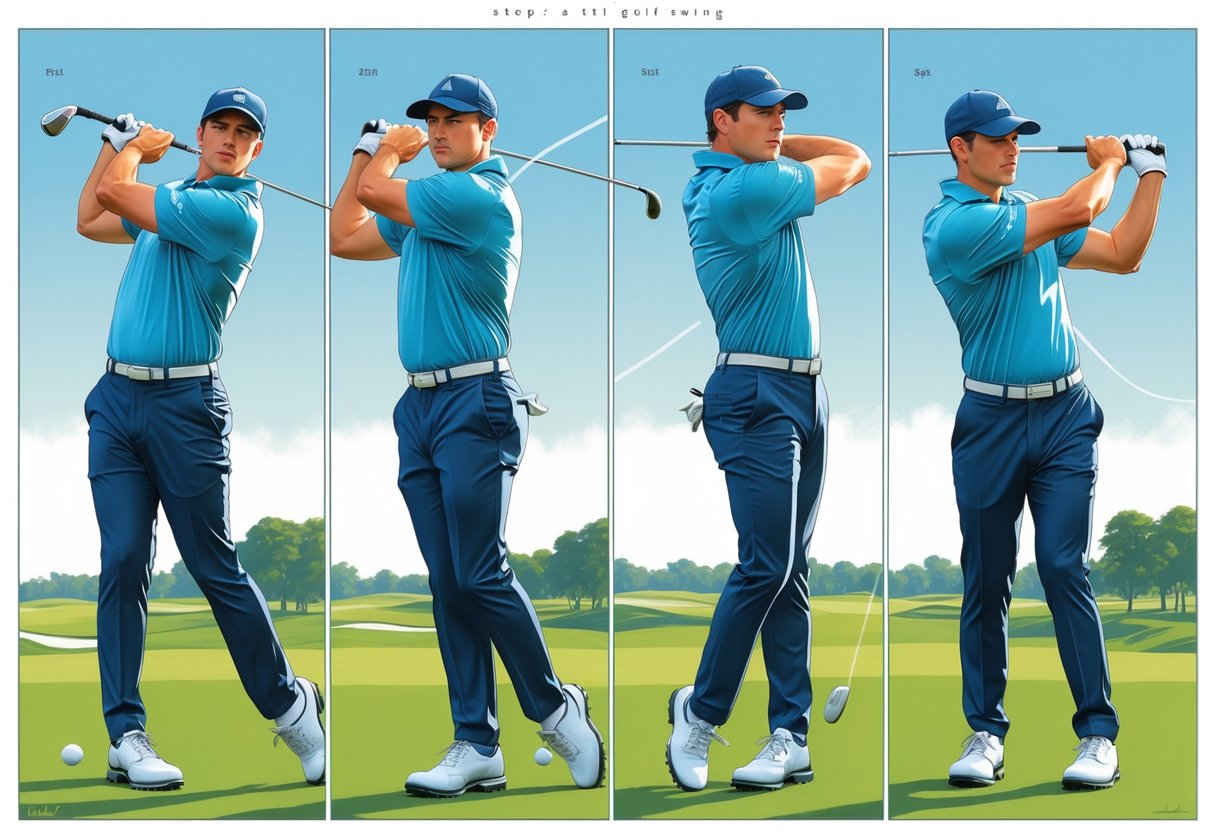
This post breaks the swing into clear steps. You’ll find practical drills for the range to help with timing, tempo, and contact.
Expect short, actionable tips that keep things simple and build consistency.
Key Takeaways
- Build a reliable swing by nailing the setup and sequence.
- Focused drills quickly improve contact and timing.
- A balanced finish reflects a well-executed swing.
Fundamentals of the Perfect Golf Swing
This section focuses on the specific body positions and motions that produce consistent contact and reliable ball flight. You’ll see how grip, posture, rotation, and sequencing work together, what to look for at impact, and which common errors to ditch.
Understanding Golf Swing Mechanics
Think of the swing as a sequence: setup, backswing, transition, downswing, impact, and follow-through. At setup, your grip, stance width, ball position, and spine angle set the stage for everything that follows.
A proper grip lets you square the clubface. A balanced stance keeps you stable throughout the motion.
During the backswing, rotate your shoulders and coil your torso while keeping your lower body stable. This stores energy without swaying.
Start the downswing by opening your hips toward the target. That hip lead creates the right sequence and keeps “lag” between your hands and the club.
At impact, aim for forward shaft lean with irons and a slightly upward strike with the driver. Shift your weight to your lead foot and keep your chest behind the ball.
These little mechanical details control launch, spin, and distance.
Core Principles of a Repeatable Swing
Consistency comes from a few repeatable checkpoints. Check your grip and ball position before every swing.
Keep the same spine tilt and stance width with each club to maintain your swing plane. Focus on controlled tempo and rhythm rather than chasing speed.
Use the ground: push with your trail leg into your lead leg through impact to add power. Preserve your wrist angles through the transition to hold lag and protect clubhead speed.
Practice simple drills such as slow-motion swings to groove the sequence, impact tape to check strike location, and alignment sticks for setup. Repeat key positions—don’t chase flashy moves.
Common Swing Faults and Misconceptions
Most faults trace back to setup mistakes or poor sequencing, not just the moment of impact. A slice usually starts with a weak (open) grip or an out-to-in path from early upper-body rotation.
A hook often comes from an overly strong grip or closing the clubface through impact. Chasing distance by gripping too tight or overusing your wrists just kills rhythm and contact.
Don’t try to “lift” irons—hit down with a descending strike. With the driver, avoid standing too tall or you’ll move the low point back and hit thin shots.
Forget the idea of a single “perfect” move. Work on one measurable change at a time—grip, posture, or hip lead—and test it on short shots first.
Essential Pre-Swing Setup for Success
Get your hands, feet, and body in the right spots. A neutral grip, stable stance, and correct ball position set you up to strike the ball cleanly.
Golf Grip Types and Hand Placement
Your grip controls the clubface. Use a neutral grip where the “V”s formed by your thumbs and index fingers point between your chin and right shoulder (for right-handers).
That helps the clubface return square at impact. Choose a grip that locks your hands together and feels comfortable.
The overlap (Vardon) grip puts your right pinky over the space between your left index and middle fingers. The interlock grip links the right pinky and left index finger for more unity.
The ten-finger (baseball) grip keeps all fingers on the club and helps beginners or those with less hand strength. Check hand placement by looking down: you should see two knuckles on your lead hand.
Wrap the trail hand so its palm covers the lead thumb. This keeps the hands working as one and reduces last-second wrist flips.
Stance, Posture, and Alignment
Stand with your feet shoulder-width apart for most irons and a bit wider for woods and driver. This provides balance and space for rotation.
Shorter clubs can be used with a slightly narrower stance. Hinge from your hips, not your waist, and keep your back fairly straight.
Let your arms hang naturally from your shoulders. Bend your knees a bit to create an athletic posture—don’t lean forward from the lower back.
Align your clubface to a small intermediate target first, then set your feet, hips, and shoulders parallel to that target line. Try an alignment stick drill on the range: one stick on the ground along the target line, another parallel to your feet.
This builds a reliable body line and helps prevent common aim errors.
Ball Position Adjustments
Ball position refers to the location where the club meets the turf. For short irons (wedge to 9-iron), put the ball near the center of your stance to hit down and compress it.
That encourages crisp, downward strikes. Move the ball a bit forward, about one ball width, for mid-irons (7–5 iron).
For long irons and hybrids, move it farther forward to meet the ball a little earlier in the arc. With fairway woods, put the ball about 2–3 inches inside your lead heel.
For the driver, tee the ball off the inside of your lead heel so you catch it on the upswing. These small, consistent changes in ball position match the swing arc to the club length.
Weight Distribution and Balance
Start with a roughly 50/50 weight distribution among the feet, toes, and heels. This balanced base helps you start the swing in control and promotes a proper weight shift.
During the backswing, shift about 60% of your weight to your trailing foot, but don’t sway. Keep your lower body steady and rotate into the bigger hip and shoulder turn.
On the downswing, shift weight toward your lead foot, ending with most of it on the front side through impact. Feel grounded but springy.
If you lose balance, check your stance width and posture. Practicing slow swings with focus on weight shift builds a repeatable pattern that improves both contact and power.
Golf Swing Sequence: Step-by-Step Breakdown

You need a smooth chain of moves that link setup to impact. Focus on a clean takeaway, a controlled backswing, and a hip-led downswing with proper shift.
One-Piece Takeaway Foundations
Start the takeaway with your shoulders and chest—not just your hands. Take the club back as one unit so arms, hands, and shoulders move together.
This keeps the clubhead low and on plane for the first few feet. Keep wrists quiet and avoid early hinge.
This preserves width and prevents flipping later. Make sure your weight stays slightly on your trail foot and your spine angle stays steady.
Use a slow tempo here. A steady takeaway sets the groove for the backswing and helps with clubface control.
Perfecting the Backswing Motion
Rotate your torso and hips together while your trail knee flexes a bit for coil. Let your lead arm stay fairly straight to keep width and control the swing plane.
Add a gradual wrist hinge as the club passes parallel to the ground. Time this hinge so you still feel connected—don’t let the hands get ahead of your body.
At the top, your trail shoulder should be under your chin. Your lead heel might lift slightly, a sign you’ve built good coil and stored energy.
Top of the Swing Position
At the top, the club should sit on or near the target plane while your wrists form a stable angle. Your lead arm and shaft should point roughly toward the target line.
Your weight should be approximately 60% on the trail foot, but you still need sufficient balance to initiate the transition. The hips are rotated back, and the chest faces slightly away from the target.
Don’t sway or let your lead shoulder lift too much. A compact, athletic top makes the downswing sequence repeatable and keeps the club on plane.
Transition and Downswing Sequence
Start the transition with a small hip turn toward the target. Let your lower body lead and your hips clear before your hands release the club.
Shift weight from the trail to the lead foot smoothly. That transfer drives the club down the right path and helps square the clubface at impact.
Hold your wrist hinge until just before impact to preserve lag and clubhead speed. Release the hands only as your hips open and your torso rotates fully toward the target.
Finish the downswing with your chest over the ball and most weight on your lead leg. This sequence—hip lead, weight transfer, late wrist release—creates consistent contact and better ball flight.
Impact Position: Achieving Clean and Powerful Contact

You want to arrive at impact with the clubface square, a slight forward shaft lean, and your body rotated so you can compress the ball. These elements control direction, launch, and distance.
Proper Impact Position Fundamentals
At impact, open your hips to the target by about 20–30 degrees while your shoulders remain slightly behind. This creates a stable base and keeps your weight on the left side (for right-handed golfers).
Check your posture—keep spine tilt from setup, so you don’t stand up or collapse at contact. Your hands should lead the ball by a little more than at address for most irons.
That forward hand position helps you deliver a descending blow and keeps the clubface square. Keep your head steady and eyes on the back of the ball for a consistent strike point.
Try a simple checkpoint: if the toe of the club is slightly up and the sole makes crisp turf contact after the ball, you hit a true impact position.
Club Path, Swing Plane, and Angle of Attack
Your club path should run slightly inside-to-outside for a draw or slightly outside-to-in for a fade. The key is maintaining a consistent path relative to the clubface.
Check your path by watching where the clubhead actually moves through impact, not just what you think it feels like. Video from later on is a game-changer for spotting real path errors.
Try to match your swing plane to the shaft angle you set at address, all the way through impact. If you let the plane get too steep or too flat, your angle of attack changes, and suddenly you’re thinning or chunking shots.
Angle of attack really matters. With irons, you want a downward strike for compression and clean turf contact. For drivers, aim for a slightly upward angle to boost launch and cut spin.
Control your clubhead speed using tempo, not just brute force. Swinging faster without the right path or plane usually leaves your clubface open or closed at impact, and contact suffers.
Compressing the Ball for Optimal Strike
Compression occurs when the clubface compresses the ball into the turf, causing it to spring forward. To get that, keep your hands ahead and shift your weight toward the target through impact.
This creates a descending blow for irons and a solid, center-face hit. Always try to hit the ball first, then the turf.
Here’s a simple drill: set a coin or towel just behind the ball. Hit the ball, then the towel. If you’re striking the ball cleanly before the ground, you’re compressing it right.
Watch your strike point on the face—it should be near the sweet spot for maximum energy transfer.
Forward Shaft Lean and Lead Wrist Role
Forward shaft lean means your hands lead the ball at impact. This delofts the club a bit, giving you a more piercing launch and better turf interaction.
For irons, you really need that clear forward lean. With drivers, it’s less obvious, but still handy if you want a lower-spin shot.
Keep your lead wrist flat or slightly bowed at impact. That supports shaft lean and keeps the face square. If your wrist is cupped, the face opens up, and you lose compression and distance.
Try this: use a short iron and practice half-swing, focusing on keeping the lead wrist firm through impact. Make sure your hands beat the clubhead to the ball, and the ball pops off the face before you brush the turf.
Follow-Through and Finish: Keys to a Balanced Conclusion
A solid follow-through ties together your body turn, weight shift, and arm extension. Hold your finish for a beat—check that most of your weight sits on your lead foot, your chest and hips face the target, and the club rests over your front shoulder.
Swing Extension and Finish Position
Let your arms extend fully through impact so the clubhead swings on a wide arc. Keep your lead arm straight for a bit after impact while your wrists naturally unhinge.
This extension keeps the clubface square and helps you make cleaner, more reliable contact. Finish with the club high and the shaft wrapped slightly around your front shoulder.
If your club finishes low, you probably held off the release. If it wraps far behind, you may be over-rotating your arms. Little tweaks here make a difference.
Balanced Finish for Consistency
Shift nearly all your weight to your lead foot by the end. Your trail foot should be on its toes or turned out, indicating that you effectively transferred your force.
Keep your chest and hips turned toward the target. If your torso faces the target but you’re leaning or tilting, you lose repeatability.
Practice holding the balanced finish until the ball lands. That builds muscle memory and helps you check your weight and rotation.
Role of Trail Shoulder and Upper Body
Your trail shoulder drives the start of the downswing, then needs to get out of the way in the follow-through. After impact, let your trail shoulder open up and move behind you as your chest rotates toward the target.
This clears space for the club and prevents a blocked or weak finish. Don’t force the trail shoulder forward—let your hips lead the turn.
If your upper body stalls, your arms will try to save the swing, and the face can flip open or closed. A smooth, connected upper-body turn gives you a controlled follow-through and a finish you can trust.
Common Follow-Through Mistakes
Bringing your arms to a stop immediately after impact is a common mistake. It kills clubhead speed and leads to inconsistent shots.
Fix it by always committing to full arm extension and a natural wrist release. Falling back on your trail foot or leaning away from the target ruins your balance.
Check your foot pressure—most of your weight should be on your front foot. Watch out for the “chicken wing,” where your lead elbow bends through the follow-through. That shortens your arc and weakens shots, so keep the lead arm extended a bit longer.
Advanced Drills and Techniques for Building a Consistent Swing

These drills are all about repeatable moves: sequencing from the ground up, squaring the clubface at impact, and shifting your weight reliably. You’ll use targeted drills, video feedback, and feel-based exercises to fix specific faults and build a swing you can count on.
Golf Swing Drills for Improving Mechanics
Pick drills that train positions and timing. The impact bag drill helps you feel forward shaft lean and a solid lead wrist at contact.
Swing into the bag with short, controlled swings to rehearse compression and a descending strike with irons. The step-through drill emphasizes lower-body movement and develops balance.
On the downswing, step your trail foot forward so your hips rotate and your weight shifts left. This builds separation between hip turn and arm swing.
Try the towel-under-arms drill to keep your arms connected to your torso during takeaway and backswing. These three drills together target the plane, connection, and impact feel.
Video and Swing Analysis Tools
Record your swings from down-the-line and face-on angles with your phone. Use slow motion to check club path, face angle at impact, and hip rotation timing.
Mark key frames: address, top of backswing, and impact. Basic apps let you overlay lines or measure rotation to spot over-the-top moves or early extension. Compare yourself to a model swing and identify where your club deviates from the plane or your hips stall.
Combine video with on-course tests. Record a swing, change one thing, and hit five balls. This feedback loop accelerates learning and prevents the repetition of mistakes.
Addressing Over-the-Top and Early Extension
If you swing over the top, work on dropping your hands on the downswing. Try the pump drill: pause at the top, rehearse the hip bump and arm drop twice, then swing through.
This move grooves the right inside path and fights the outside-to-in swing that causes slices. For early extension, build better posture and hip rotation.
Stand close to a wall with your trail hip near it and make half swings. If your hip bumps the wall, you’re extending too soon. Focus on rotating the hips back and down, rather than pushing them toward the ball.
Combine these with impact bag drills to reinforce proper impact posture. Hold your spine angle into the bag so you know where to stay through contact.
Drills for Weight Transfer and Clubface Control
Work on weight shift with the step-through and lunge-step drills. Start with a normal backswing, then step your trail foot forward on the downswing to force weight onto your lead leg.
Go slow until you can repeat it without falling over. For clubface control, use the impact bag and short swings focused on squaring the face at impact.
Lay an alignment stick on your target line and practice swinging so the clubshaft tracks parallel to it at hip height. This helps you see if the face is open or closed.
End with focused reps: 10 impact bag hits, 10 step-throughs, and 10 alignment-stick swings. Jot down what felt different and use video to double-check face angle and weight shift.
Driver Swing Mechanics: Maximizing Distance and Accuracy
You want a steady setup, the right swing sequence, an upward strike at impact, and a sense of clubhead speed. Each part affects launch, spin, and direction for long, accurate tee shots.
Driver Swing Setup and Ball Position
Set the ball just inside your lead heel so the club meets it on the upswing. That forward ball spot gives you space to sweep the ball off the tee and launch it higher with less spin.
Widen your stance so your heels sit just outside shoulder width. A wide base keeps you balanced during a big turn and cuts down on swaying.
Tilt your spine slightly away from the target so your lead shoulder sits higher than your trail shoulder. This tilt helps you hit the ball.
Apply approximately 55–60% of your body weight to your trail foot at address. That allows you to load in the backswing and shift your weight forward in the downswing.
Driver Swing Sequencing
Start the downswing by bumping your hips, not your hands. A small movement of your lead hip toward the target shifts your weight and creates space for your arms to drop inside.
This ground-up sequence creates “lag,” where the clubhead trails your hands and stores speed until just before impact.
Keep your takeaway connected—turn your shoulders and torso together. If you lift the club with your hands, you lose clubhead speed and width.
On transition, resist going over the top. Let your hips lead, then your torso, arms, and finally the club follow. That order squares the face and helps you hit it straighter.
Angle of Attack for Driver
Try to hit up on the ball with a positive angle of attack, somewhere between +2° and +6°. Hitting up cuts spin and boosts launch for more carry.
The forward ball position and spinal tilt facilitate this. Tee the ball so that half of it sits above the driver face at address to facilitate an upward strike.
If you hit down, you’ll get more spin and a lower launch, resulting in less distance. If you swing too steeply upward, you might miss the sweet spot or lose face control.
Use a launch monitor to check the angle of attack and spin. Small tweaks to ball height, tee position, and spine tilt can add real carry and roll.
Adjusting for Clubhead Speed
Clubhead speed sets your distance ceiling, but good mechanics turn it into usable power. Add speed by widening your arc, keeping lag, and rotating fully through the ball.
If you need more speed, work on sequencing and width before just swinging harder. Leading with the hips and delaying the release helps you add speed at impact.
At higher speeds, reduce dispersion by squaring the face at impact and maintaining a consistent swing path. Narrow your stance a touch or reduce sway if you start losing control.
Monitor your ball flight and adjust loft or tee height to optimize launch for your speed. Sometimes, a small setup change can translate extra speed into real distance without sacrificing accuracy.
Frequently Asked Questions
This section gives you clear, practical answers for the range. You’ll find setup details, drills and exercises, why follow-through matters, and step-by-step swing sequence points to practice immediately.
What are the key components of a proper golf swing setup?
Stand with your feet about shoulder-width apart if you're using short irons. Go a bit wider if you're hitting a driver.
Bend your knees slightly, hinge at your hips, and let your spine tilt forward. Allow your arms to hang loosely and naturally.
Hold the club with a neutral grip—don’t go too strong or too weak—so you can square the clubface at impact.
Line up your feet, hips, and shoulders so they're parallel to your target line. Move the ball forward in your stance for longer clubs.
Try to keep your weight balanced, but lean ever so slightly toward the balls of your feet.
Aim the clubface and tweak your setup as needed before you start the swing.
How can I improve my follow-through in the golf swing?
Focus on finishing tall, with your chest and hips facing the target.
Let your arms stretch out fully, and let the club wrap around your body without forcing it.
Hold your finish for a few seconds to verify your balance.
Try swinging in slow motion to get a sense of the correct sequence—hips first, then torso, then arms.
Practice drills such as half-swings that finish high to achieve a full release.
Record your swing on video now and then. Sometimes you spot a rushed finish or early deceleration you didn’t realize was there.
Why is follow-through important in a golf swing?
The follow-through indicates whether you executed the sequence correctly and remained balanced through impact.
When you finish well, you’ve held your posture, shifted your weight, and let the club release as it should.
Poor follow-through usually points to earlier swing issues, like losing your posture or quitting on the shot.
Finishing your swing helps you hold clubhead speed and keeps your shots on line—at least, that's the idea.
What are the most effective exercises to enhance my golf swing follow-through?
Try medicine ball rotational throws—they’re great for building that hip-to-shoulder power.
Standing trunk rotations with a resistance band can help you achieve greater torso rotation and improved control.
Perform single-leg balance holds or quick lunges to enhance stability after impact.
For a clean release, toss in some wrist and forearm exercises with light dumbbells.
Slow swing reps in front of a mirror can really groove that full finish.
Honestly, a few focused minutes of practice beat slogging through endless, unfocused swings.
Can you break down the golf swing into simple steps from setup to follow-through?
Start with your setup: stance, spine angle, ball position, grip, and alignment.
For the takeaway, rotate your shoulders smoothly and keep the club low and close to your body.
In the backswing, turn your torso and hips, and try to keep your lead arm fairly straight.
During the downswing, shift weight to your front foot, start turning your hips, and let your arms follow through.
At impact, keep your hands just ahead of the ball for irons, and make sure the clubface is square.
Then, extend your arms and finish tall, with your weight on your lead leg and your chest facing the target. Simple enough—on paper, at least.
What is the difference in swing technique when using irons versus other golf clubs?
With irons, you usually go at the ball with a more downward angle. The goal’s to compress it and take a small divot—feels satisfying when you get it right.
You’ll want to keep the ball more centered or even a touch back in your stance, at least compared to where you’d put it for woods or a driver.
Drivers? Totally different vibe. You need a shallower, upward strike, and the ball sits way forward in your stance.
Most people stand taller, go with a wider stance, and try to make a longer turn to really whip up some clubhead speed.
Wedges call for a compact swing and a steeper angle of attack. There’s usually more wrist hinge, which helps with control.
It’s smart to tweak your tempo and ball position, depending on the loft and the shot shape you’re going for.
DISCAIMER
This document is provided for general information purposes only and should not be relied upon as providing legal advice, technical, or specific operational guidance to the reader, whether as to the practices described in the document or the applicable legal requirements and regulations. Progolfinsider.com expressly disclaims any responsibility for liability arising from or related to the use or misuse of any information in this document.